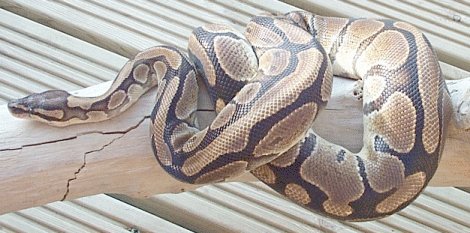
Royal Python
.
|
Everyone seems to have Royal
Pythons - a very commonly kept snake - but not really one
for the beginner
|
|
The Royal Python is a snake
that averages about 4 feet in length; occasionally a female
can reach 6 feet, but it's rare. The largest royal I've
personally seen was a five feet long male.
They are generally docile snakes by
nature, and are head shy and easily
frightened.
|
|
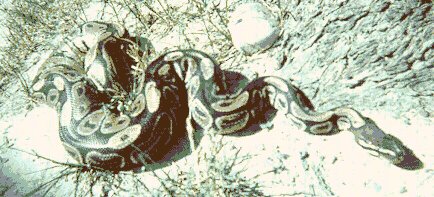
Ball - Royal - names can be
confusing:
Called Royal Python because its markings
look like crowns - common name in the UK
Called Ball Python because of its natural
form of defense. When one feels threatened in some way it will coil
into a tight ball until the threat is past - common name in the
US
|
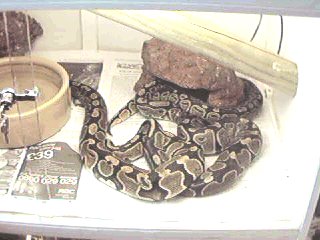
Because of the smaller size of
the Royal Python compared to many other pythons, an ideal
viv size for a happy snake is 4 ft long X 2 ft wide X 2 ft
high. Give them something to hide in - a Royal will love to
squash himself into nooks and crannies. But don't keep just
one; Royals seem to love company. My first royal sulked, but
when I added a second both fed. Odd, as in the wild they are
solitary animals.
|
|
I now have twelve Royals
spread among three tanks. Four female Royals in one tank,
three problem feeder males in another, and five greedy lads
in the third. It's also been my experience that Royals feed
better in larger numbers and in smaller tanks. Again this
doesn't really fit with what would happen in the
wild.
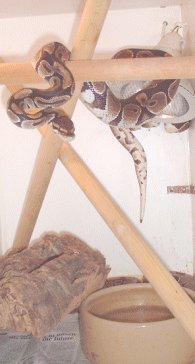
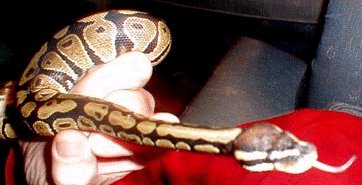
Royals seem to like to climb -
Beverley here is in his (!) climbing frame which was
constructed from thick wooden dowels. A word of caution
though - Royals are rubbish at climbing and fall out very
easily. Don't let them climb too high or they may well hurt
themselves.
|
|
|
Royal Pythons will require
supplementary heating in all areas outside the tropics. The
air temperature in the cage should be maintained at 77 to 88
degrees F during the day, (you ca reduce to around 68
degrees F at night) - Royals like it warmer than most
snakes, but do not seem anywhere near as prone to colds as
burmeses
|
|
A well fed Royal will shed its
skin about once every 1 to 3 months. The most obvious sign
that shedding is imminent is a general darkening and the
clouding over of the eyes. At this point, all contact with
the snake is best postponed till after shed is complete. The
eyes will clear, and a few days later the skin will be
removed. The shed is accomplished by rubbing on something
until the skin on the nose comes loose. The skin is then
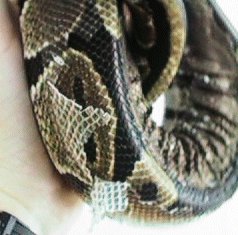
pulled off like a sock. Check the python to ensure the shed
was complete - look for any skin left stuck to the body.
Unshed skin can be removed by soaking the snake in water and
then gently pulling it off.
|
|
|
Some snakes seem to enjoy
this, others put up a struggle. If the skin comes off in
lots of small pieces, the books would have you believe that
humidity is too low. I regularly have Royals shedding within
days, if not hours of each other. One snake will shed
completely without a problem and the other will have a
really hard time and will need soaking & peeling,
and this from snakes in the same viv. There must be a
reason, but I don't know what it is.
Handling should be kept at a
minimum during the shed period, as the new skin can be
sensitive (or even damaged). Feeding should also be
postponed for the same reasons, in fact, most will refuse
food while shedding.
|
|
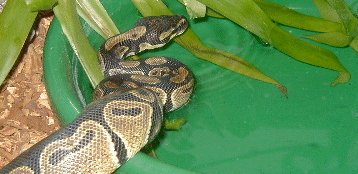
Snakes need water available at all times. When
I very first started keeping royals I was warned not to
let them have too large a water bowl or they would soak too
long in the water.
Mine don't soak, and I don't see why they shouldn't soak.
Any ideas why they shouldn't ?
|
|
|
Some words on
"types" of royal python
There are various types of royal
python, most of which look much the same to
me.
|
|
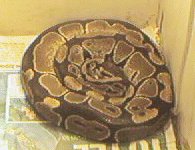
Standard royal python (Scott).
Did you know they are called Royals as the markings are
supposed to look like crowns.
(They don't really, do they
?)
|
|
|
|
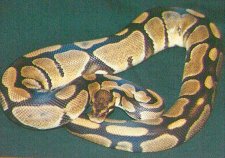
The "high yellow" phase -
similar to the "typical" but much lighter in colour. Though
what makes a snake "high yellow" and not just a bit pale is
arguable.
This is "Lamby" - photo courtesy of
Clint Gilders
|
|
|
|
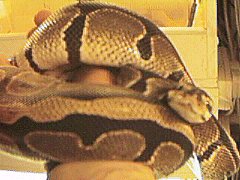
The "striped" royal has a
stripe down his back. This one is my own
Derek.
|
|
|
|
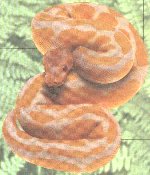
The Albino Royal is rather
rare, and very expensive, but in other ways is reported to
be much the same as "normal" Royals in behavior.
I was given this piccy by my
local herp shop
|
|
|
|
There's also "jungle" phase,
but there's as many ideas of what this looks like as there
are people trying to sell "jungle phase" Royals. All
the ones I've seen look rather like normal Royals to me.
There is also a "piebald" phase where large spaces of the
snake's body are a pale white. They are very expensive and,
to my mind, look horrible.
|
|
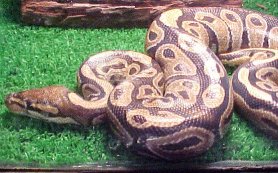
All things considered, THE
python to keep - don't get huge like retics, don't have
permanent colds like burmeses, don't bite me like carpets
and children's, good natured, a manageable size - so here's
the catch..
|
|
...
|
Feeding
|
|
|
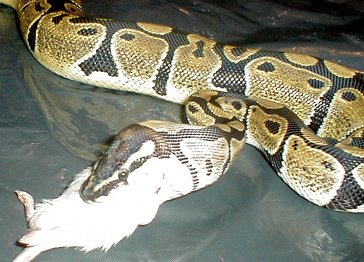
|
Not my snake I'm
afraid, but this photo must be the dream of every
keeper of royal pythons. You see Royals can be
little ***s when it comes to feeding. Generally
they don't feed !
Really -more often than
not they don't eat. Where my rosy boas will eat all
day long every day, and a carpet python would make
an ideal dustbin, royal pythons have been known to
starve themselves to death.
|
|
|
Now the experts would say
something like "rats are a good food source for Royals
over the size of 2 feet and before this mice should be used,
their size in accordance with the python's size. Two mice a
week should do. After the 2 foot mark, Royals will graduate
to smaller rats or adult mice As the snake matures, larger
rats should be used."
|
Ashley (pictured here)
would agree
|
|
Ken (pictured here) will
only occasionally eat.
|
|
|
So many Royals are fussy
feeders. When Ken does eat, it will be a (dead) gerbil which
was put into her (see my comments on sexing snakes
elsewhere!) viv and left overnight, Another adult royal
of mine, Beverley is much the same. Beverley will also go
months between feeds with no apparent harm befalling him
(!). It is not unknown for Royals to go over a year without
eating.
Another of my Royals, Keith, will
feed if his mouth is opened for him and the food item placed
between his jaws. I don't have to force the food item
down his throat or employ any other "force feeding"
techniques - I just have to open his mouth and put it in for
him !!
Many experts also advocate waving
the food item in a pair of forceps to encourage feeding.
Others say leave the food alone. A tip - whatever way you
feed a python don't forget they have heat detection organs
in their snouts. They can smell food, but they "see" your
warm hand and will bite it. Wear gloves when feeding Royals
!!
There are those Royals which will
only eat gerbils, and some that will only eat certain
colours of prey - the trick is to persevere until you find
something they like. See also the "Got
a Question" page and the
"Feeding
Time" page to deal with
difficult feeders.
|
|
Breeding
|
|
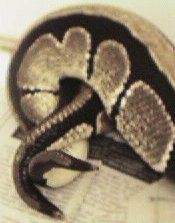
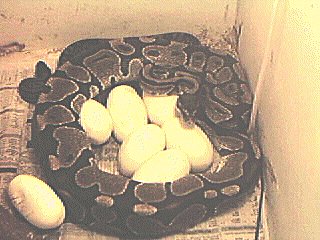
I've never deliberately tried to breed Royals, but I have
had them "doing naughties" on several occasions. Below is
the closest I've come to a result. At the moment all my
males & females are separated. Before
I attempt any more matings I want the females to get a
much better body weight.
|
|
One of my proudest moments was when my son woke the
entire family to tell us "Ken" had laid eggs. According to
the books pythons mate, then a month after mating the eggs
are laid. They had been off mating for some time, and I had
decided the matings were unsuccessful.
|
|
|
I had this idea to separate males and females for
some months then try for matings later in the year. Some
three months after separating the sexes, these eggs were
laid. However despite my moving mother and eggs onto damp
vermiculite, the eggs collapsed. I think the problem was
lack of humidity. I shall leave her to feed up for a couple
of years before mating her again.
Two months after this episode I came home from a day's
picnic to see that one of the "males" had laid eggs (see my
comments elsewhere on sexing). The mother snake was coiled
around her eggs, and to keep up the humidity I popped a damp
newspaper over her twice daily. I gave her a light
sprinkling of athlete's foot powder to keep down any mould
growth. Unfortunately the eggs lasted about a month then
deflated. If there is a next time I shall try
incubating them in an incubator made from an old laboratory
water bath.
|