|
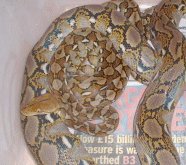
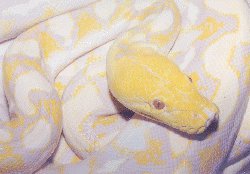
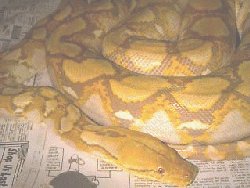
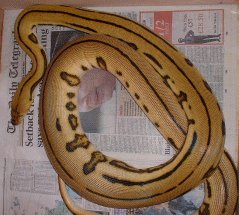
Found throughout Indochina and Indonesia,
reticulated pythons are among the fastest growing of the
large constrictors, and can exceed lengths of 25 feet. There
are rumours of females over 33 feet long; the longest snake
on record is a reticulated python.
They get very big!!
|
|
The reticulated python would
seem to be a more alert and intelligent species than the
comparatively sluggish Burmese which I have kept. There
have even been reports of individual recognition of their
owners.
I have met people who never
have any problems with the retics in their collection, but
other keepers have warned me of their nasty, even dangerous,
temperament.
|
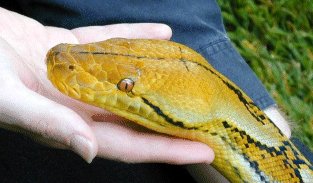
There is a school of thought which
claims that captive bred retics are quite tame, and that
only wild caught ones have a nasty temper. There is another
school of thought which disagrees.
|
|
Are they nasty snakes? Or are they
ideal large snakes ?
Personally I don't know, but I'm
hearing more good things than bad about them these days.
Here's a little true story that speaks volumes about
retics.
|
After 22 months the snake still had not
eaten a thing and had lost over 100 pounds. The vet
was send on a housecall to give medication to the
snake to induce hunger. The vet said the retic was
coiled up in the corner and the stack of coils went
about 3 feet high and the head of the snake was
about the size of a shoebox just looking at him as
he prepared to inject the medicine into the snake.
The vet said he was never so scared in his life
holding a syringe in his hand about to give it to a
20+' retic.
But the vet found that the snake was very docile
and the injection didn't even phase
him.
|
|
|
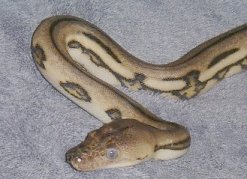
Over the last few years
various Dwarf retics have become available, however their is
controversy over their final size. Topping out between eight
to twelve feet, these snakes would seem to be far more
docile than their larger cousins. It's no secret I'd love a
pair of dwarf retics - I just don't have the
space.
|
|
|
Reticulated pythons seem to
fare best when maintained at temperatures ranging from 80 -
85 degrees F. during the day and around 78 degrees F. at
night. A heated basking spot should be provided at all times
as well as a dark hiding
spot.
Retics seem to prefer moderate
to high levels of humidity which can be accomplished by
misting their enclosure ever three to four days. You can
place their water containers over a portion of the heating
pad to help raise the relative air humidity. Any form of
substrate that is commonly used for reptiles will work well,
but it must be easily replaceable, large pythons will dump
spectacularly! Adults require a large roomy enclosure at
least 8' x 2' x 2' -ideally larger. Water should be replaced
with clean and the water bowl disinfected at least weekly.
Because of their nocturnal behavior artificial lighting is
not necessary. Apparently they do not shed their skins
whole, as many snakes do, instead the shed skin comes off in
thousands of small bits.
|
|
Reticulated pythons are among
the fastest growing of the large constrictors, and if
maintained under optimal housing and feeding conditions can
attain sexual maturity (10.5 -11.5 ft.) in 18 months, after
which breeding can soon be initiated. Cooling to the low
70's in the autumn and separating males and females is
generally sufficient to stimulate breeding activities - but
see my comments on breeding elsewhere in this
site.
|

|

|

|
|
|
|
"mind your hand"
|

|