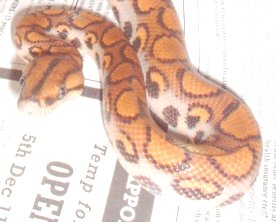
|
HOUSING:
|
|
Space:
A cage amounting to 3/4 square foot per foot of snake is
what many consider perfect. Shelves can be used to increase
floor space and allow somewhere to go when active. A shelf
also allows a warmer basking site, while forming a cooler
area underneath.
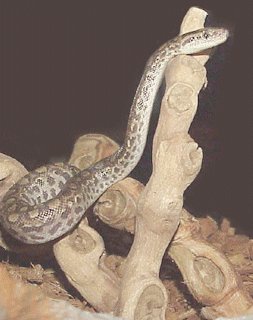
The cage should contain a hiding
place, a sturdy water bowl big enough for soaking, and
something to rub on while shedding (Rocks and tree
limbs/sticks work well).
|
|
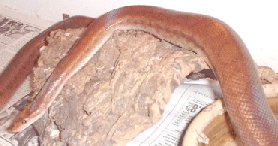
Substrate.
Keep it simple, and do not use sand or cedar chips - nothing
that they can eat along ith their food, and nothing that
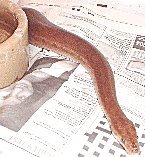
might get under their scales. Newspaper is the easiest and
is what I use. Some keepers use carpeting. I don't -
newspaper is cheap and easily replaced. Give them some cork
bark as well. They can hide under it and rub against it to
shed
|
|
|
|
Temperature.
Temperature for a Boa should be kept around 85 daytime and
80 at night. A basking site in the range of 90 to 95 is also
needed. If temperatures are allowed to stay too cool,
refusal of food, regurgitation of prey, digestive problems
and respiratory infections follow. It must also be
remembered that the temp at the bottom can be 10 to 15
degrees lower than that at the top. Be sure the basking area
is placed so that a temperature gradient is
achieved.
|
|
A word on
humidity. Normally I'm a
great believer of letting them soak if they want to be wet.
Generally I remain convinced that high levels of humidity
lead not only to the growth of mould, but to respiratory
infections too.
|

|
|
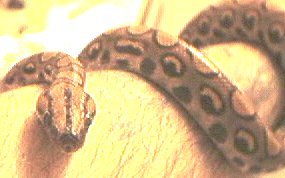
However it's been my
experience that while this approach is OK for most boids and
is OK for Columbian rainbow boas, the Brazilian ones do
prefer it damp. If I'm not misting the viv regularly they
spend all the time in the water.
|
|
Feeding: Newborns
should be fed every 5 days. Start on pinkies, and work up
from there. As the snake increases in size, feeding can be
cut back to every 10 days. Feeding can be done every 2
weeks, or even less in emergency situations, but this is not
recommended. Your pet will be much healthier if fed a
reasonable meal weekly than if gorged
monthly.
|
|
I offer my Rainbows food each
week. If there was one are in which I'd say that my
Columbians and Brazilians differed, it's their feeding
habits.
Columbians are generally good
feeders - often acting as "dustbins" for food not wanted by
other snakes, but beware - I make a point of
separating Columbians for feeding - they will all attack
each other's dinner and end in in a mutually constricting
knot.
The Brazilians are fussy - even
more of a problem to feed than my royal pythons. One
recently went eight months without feeding.
|
|
Shedding: A well fed
snake will shed about once every 1 to 3 months; shedding is
a result of growth. It's been my experience that Rainbows
shed more often than my other snakes. The beginning of
shedding is marked by the clouding over of the eyes and a
general darkening of the skin. The eyes then clear, and a
few days later the skin will be removed. The shed is
accomplished by rubbing on something until the skin on the
nose comes loose. The skin is then hung on something and
pulled off. Unshed skin can be removed by soaking the snake
in water and then gently pulling it off, (though this is not
usually a problem with Rainbows.) Some snakes seem to enjoy
this, others don't.
Going back to the humidity problem
- if a snake has trouble shedding then the humidity may be
too low.
Handling should be kept at a
minimum during the shed period, as the new skin can be
sensitive (or even damaged). Feeding should also be
postponed for the same reasons, in fact, most will refuse
food while shedding.
|
|
Breeding:
|
|
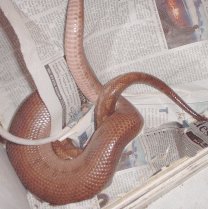
Well what can I say - I've
never intentionally tried to breed, it's just happened and,
as you can see from the pictures taken below on New Year's
Eve (Dec 31 2000) they do mate in captivity. Came as a
complete surprise to me - we had friends round - "can I hold
a snake" and so I thought to have a go with a Columbian
rainbow boa but, as you can see the snakes were
busy!
|
|
|
They've mated in previous
years, and my hopes weren't high but the matings continued
for a few weeks and as time went on the female got fatter
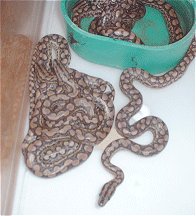
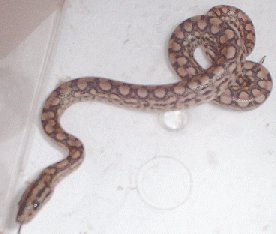
and fatter and ate less and less until the morning of May 14
2001 when I found six babies.
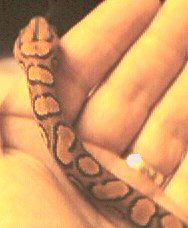
Compare the colour and
markings with the adults !!
|
|
|
|
Since May 14th there were no
more matings that I noticed. I'm not saying that they
didn't "do it", but when they do "do it", they tend to
wriggle about an awful lot and "do it" an awful lot for an
awful long time. So it's probably safe to assume that they
didn't. But eight months later on January 11 2002 three more
babies were born. Now there's something about snake
reproduction that a lot of people don't know about, and most
of the books tend keep quiet about. And that is the female
snakes only really need to mate once. They can store the
sperm (or store very young embryo snakes depending on
species) and have later litters from the same
mating.
|