Children's Python
(Liasis childreni)
I've had a pair of these that were vicious
little **** so I found a new home for them.
Are yours the same?
|
The Children's Python is a moderate to heavily built
Australian snake of variable colour. Typically it is light
brown dorsally, being lighter on the lower sides with an
irregular pattern of dark brown blotches along the back and
sides, often roughly arranged in transverse series to give
the impression of irregular crossbands, the head, light
brown often with small darker flecks or blotches. A dark
streak may pass through each eye. The ventral surface is
white. This snake averages .85 metre in adult total length
but specimens up to nearly 2 metres are known.
|
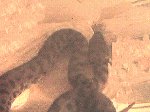
"Sabrina"
|
|
The Children's Python is one
of Australia's most widely distributed species of python and
throughout most of its range is also the most common python
generally found in rocky areas. Children's Pythons can be
nocturnal in habit due to the high day-time temperatures
throughout most of their range, although in captivity this
species may be diurnal. Unlike many pythons the Children's
Python rarely rests in the open, always sheltering in or
under some form of cover such as a rock crevice, log,
etc
According to the books, and
according to every other keeper of Children's Pythons I've
spoken to, Children's Pythons are generally hardy and easy
to feed and because nine out of ten are docile in
temperament they are an excellent snake to keep in
captivity. Mine bit freely !
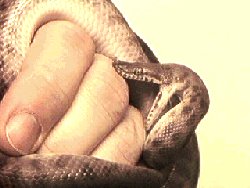
But to be fair to the snakes their
new keeper has not once had any problems with them at all -
it must just be me !!
|
|
On account of their
size Children's Pythons may be kept in cages of moderate
size, and the most important requisite for success in
keeping them is maintaining sufficient temperature (above 22
degrees Celcius) for most of the year. The setting of the
cage is usually relatively unimportant as Children's Pythons
will thrive in almost any cage so long as it is not too
moist too much of the time.
Successful breeders often
keep this species in cages with no more than newspaper on
the floor, a single hide box or horizontal log and water,
indicating the ease of keeping this
species.
|
Children's Pythons
are (in my experience) greedy little things and will avidly
take pinkies, fuzzies and small mice. Always remember the
rough rule of thumb that the food item should be as wide as
the widest part of the snake, and do not give your snake
food which is too big.
|
|
|
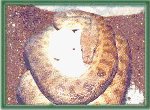
When eggs are laid they should be artificially incubated
maintaining a stable temperature of 29 degrees Celcius and a
high humidity.
|
Adult Children's Pythons
produce an average of 10-12 eggs annually around November
(in the wild) which usually take under three months to
hatch. Young when born measure 30 cm in length and weigh
roughly 7 grams . Sexual maturity comes at roughly 50 cm in
length and two to three years of age in the wild. The
Children's Python is an excellent breeder's snake, not only
because it breeds regularly and easily but also because it
often reaches sexual maturity in captivity in eighteen
months. Children's Pythons also have a good 1:1 male:female
sex ratio making it relatively easy to get breeding
sets.
|
|
A well fed Children's Python
will shed its skin about once every 1 to 3 months. The most
obvious sign that shedding is imminent is a general
darkening and the clouding over of the eyes. At this point,
all contact with the snake is best postponed till after shed
is complete. The eyes will clear, and a few days later the
skin will be removed. The shed is accomplished by rubbing on
something until the skin on the nose comes loose. The skin
is then pulled off like a sock. Check the python to ensure
the shed was complete - look for any skin left stuck to the
body.. If the skin comes off in lots of small pieces, the
humidity is too low. Unshed skin can be removed by soaking
the snake in water and then gently pulling it off. Some
snakes sem to enjoy this, others put up a struggle. Be
careful here - the Children's Python is a very small snake
and may easily be harmed. Handling should be kept at a
minimum during the shed period, as the new skin can be
sensitive (or even damaged). Feeding should also be
postponed for the same reasons, in fact, most will refuse
food while shedding.
|
|
|
|